Exposing, not depicting
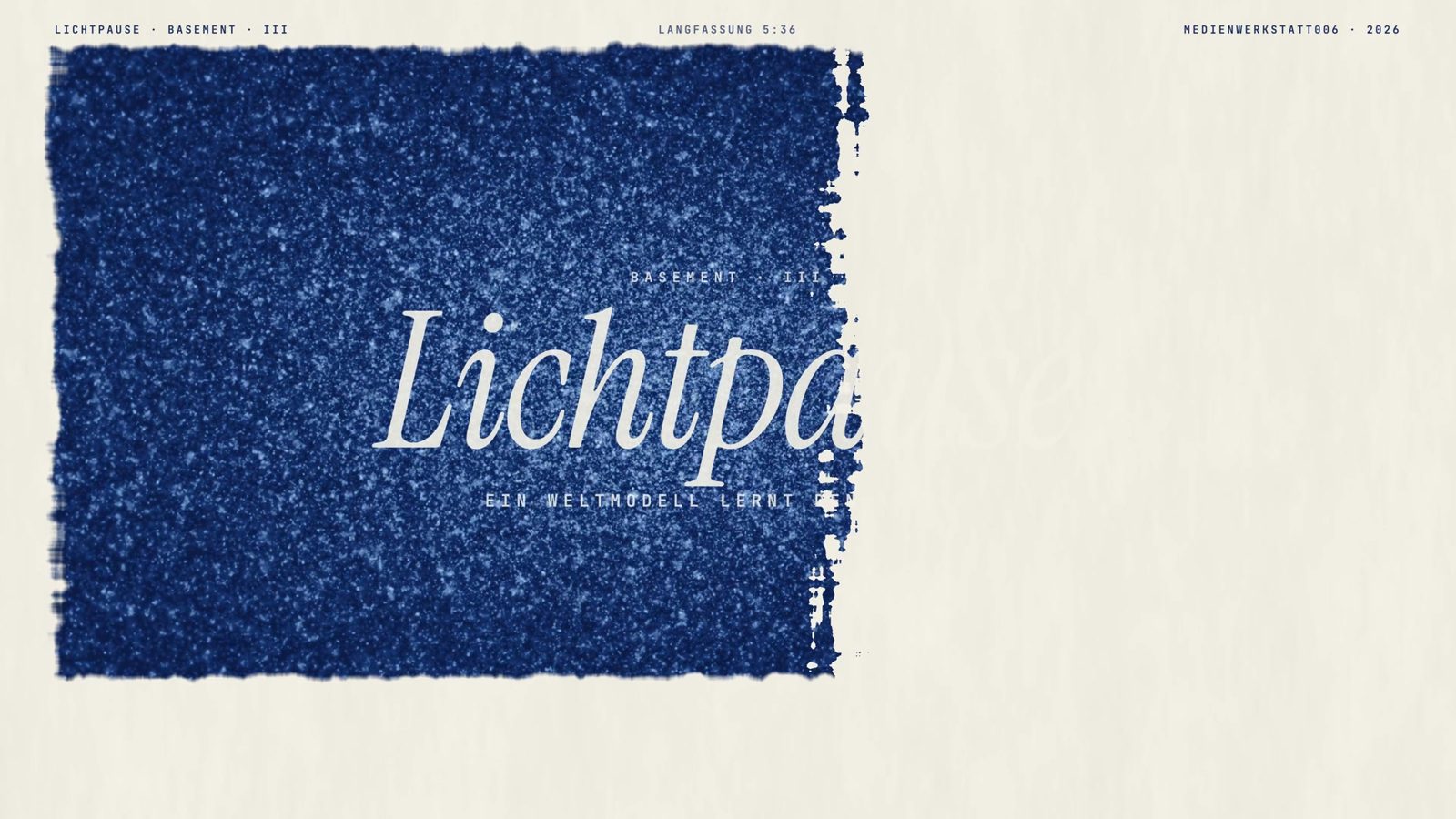
Two image processes are short-circuited: the oldest blueprint process – the cyanotype of 1842, ancestor of the architectural plan and the photogram – and the process of our present, the diffusion model, in which an image is learned step by step out of noise.
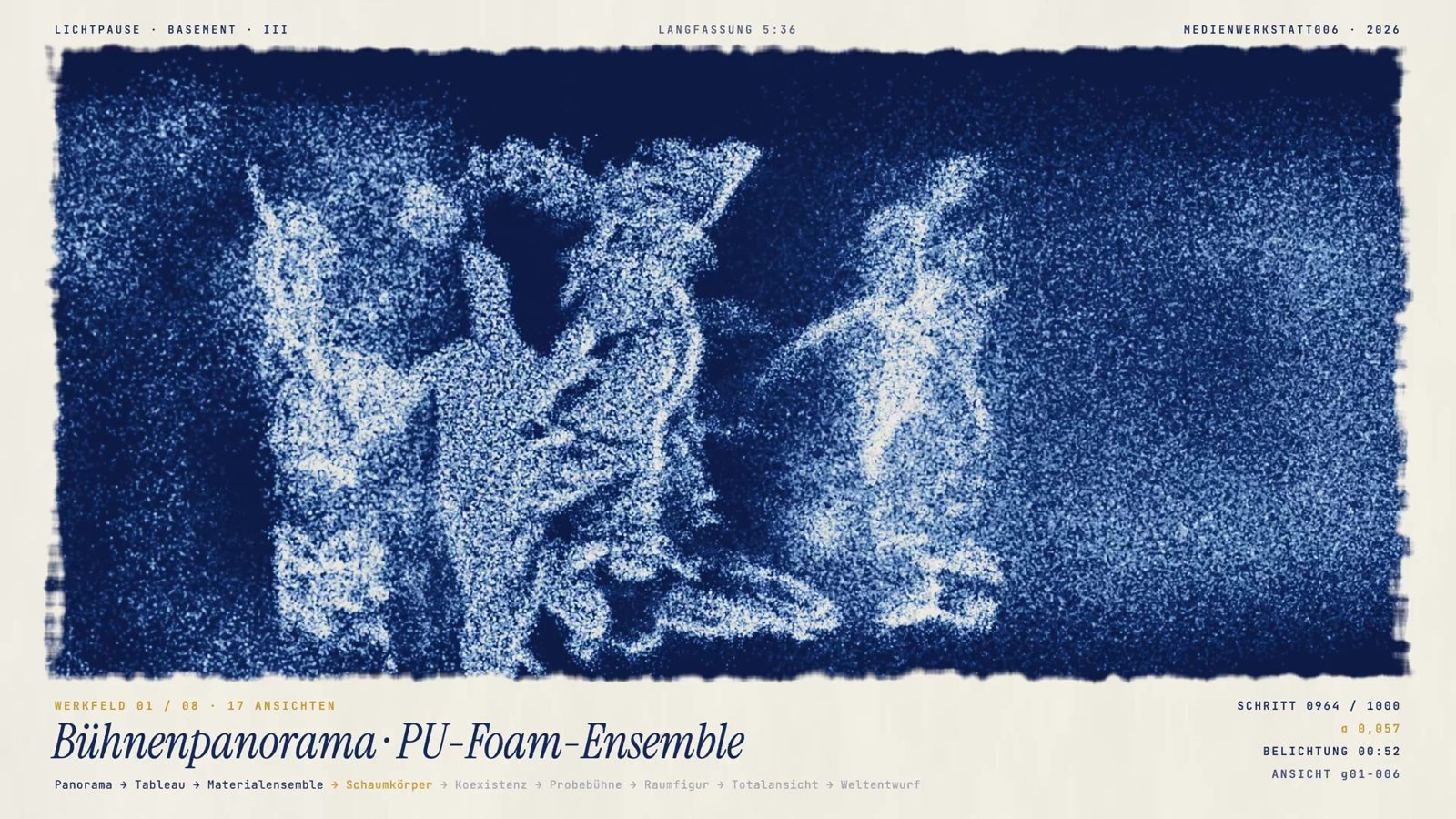
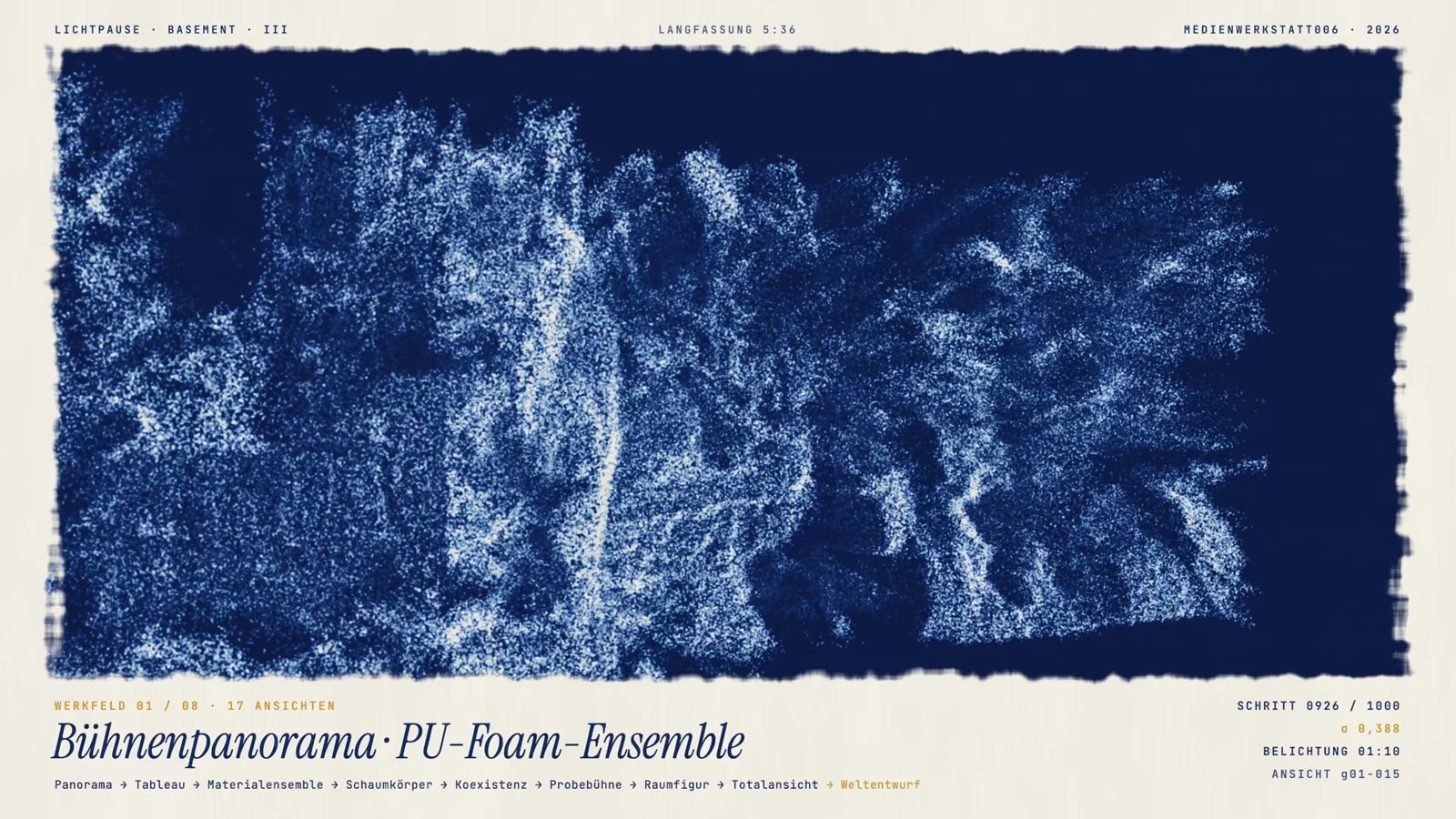
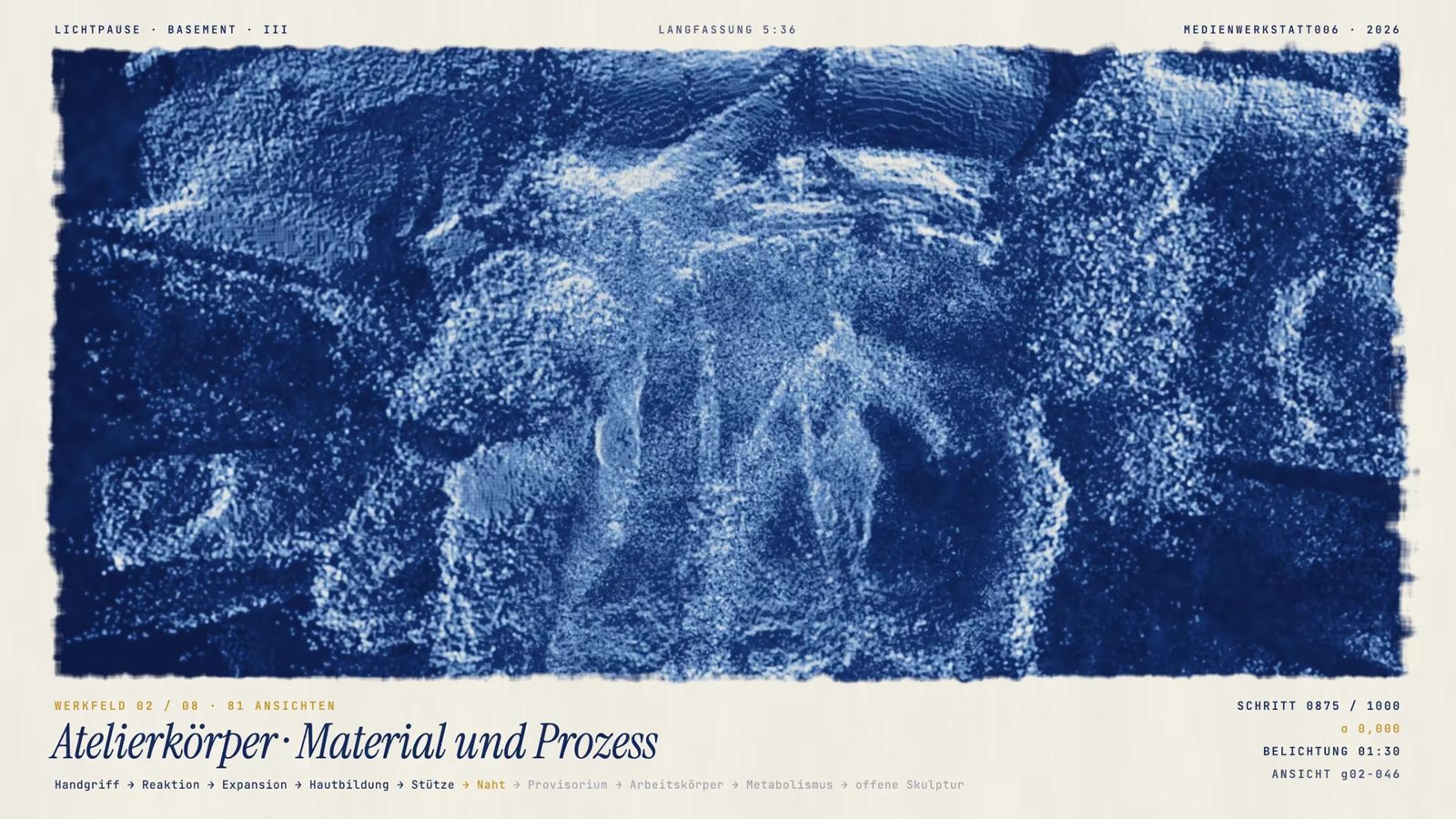
In it, the BASEMENT Studio Neulerchenfeld becomes a training data set. The 272 archive images of the eight work fields are the training views; the 419,993 points of the real scan of 29 Dec 2020 are the Gaussian grains. For a thousand steps the cellar is exposed: whatever receives light turns Prussian blue, whatever stays covered remains paper. In between, the machine misreads, hallucinates, writes the vault beyond its walls – and precisely there emerges what the series has sought since 1998: not the depiction of a place, but a procedure of inventing space.
BASEMENT · I grasped the room as a gravitational field, BASEMENT · II as a capsule of time. BASEMENT · III grasps it as sensitivity to light: an archive in permanent self-rewriting, laboratory and fossil, storage of the present and ruin of the future.
Visual language: Prussian blue on paper white, iron yellow only for readings; Instrument Serif and JetBrains Mono. Every image area is a brushstroke of light-sensitive coating with frayed edges; type inside the image is unexposed paper. Colour appears only in moments of “development”.
Sound: white noise is filtered step by step onto the eigenfrequencies of the vault (10.05 × 4.99 × 3.15 m), interwoven with the original recordings of XR SPACE 2020; exposure ticks count from 1000 to 0.
Three films
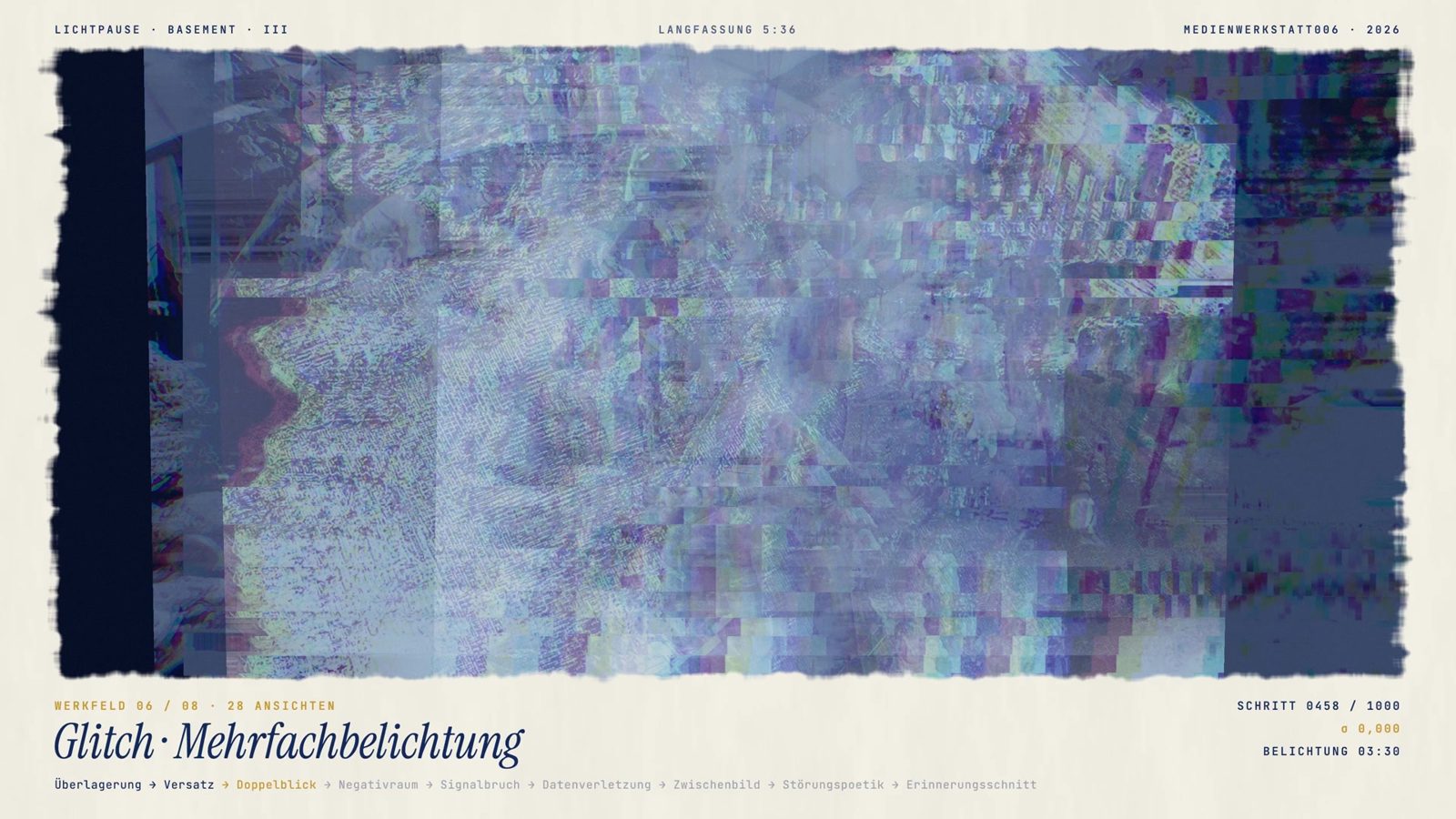
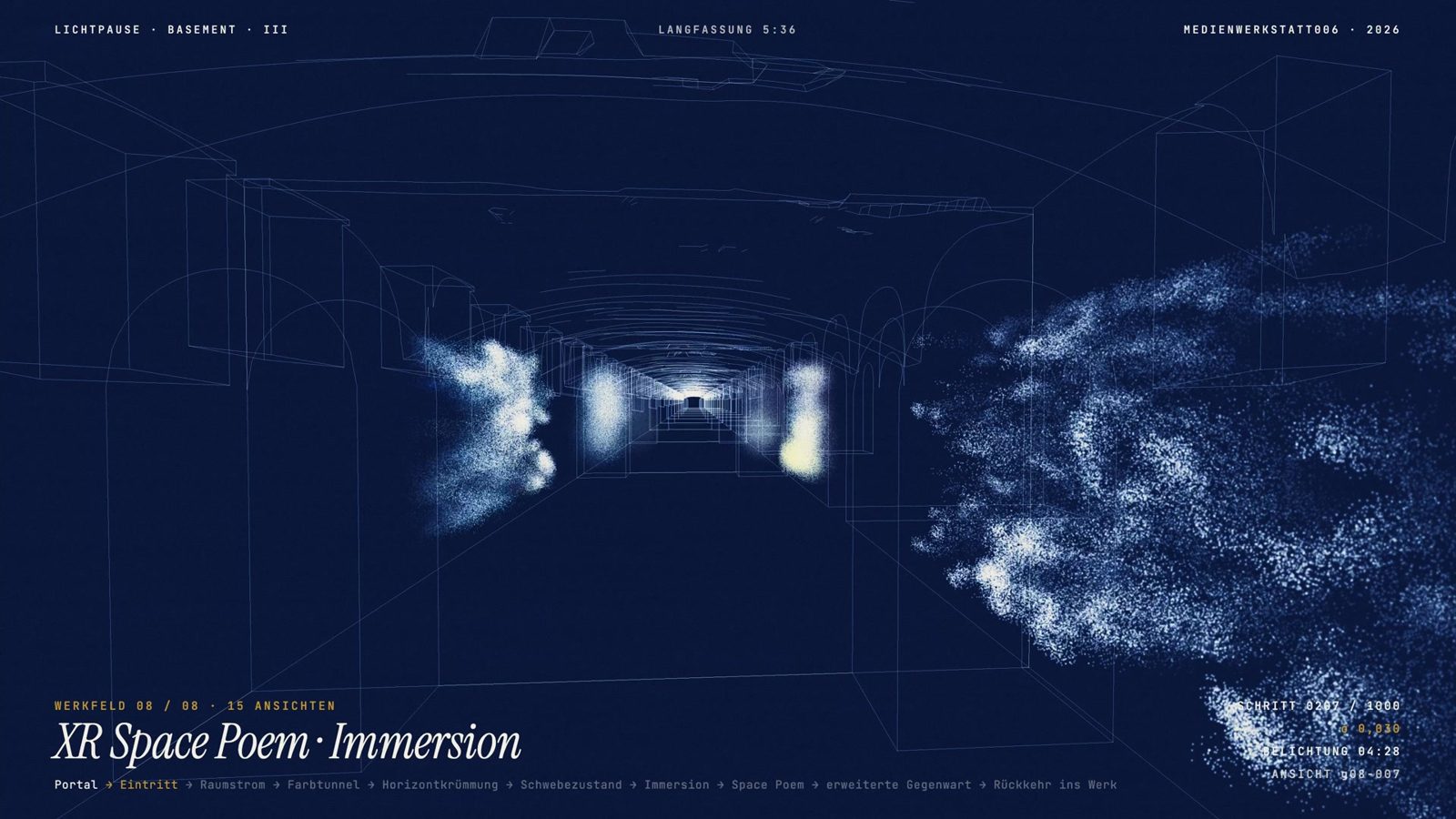
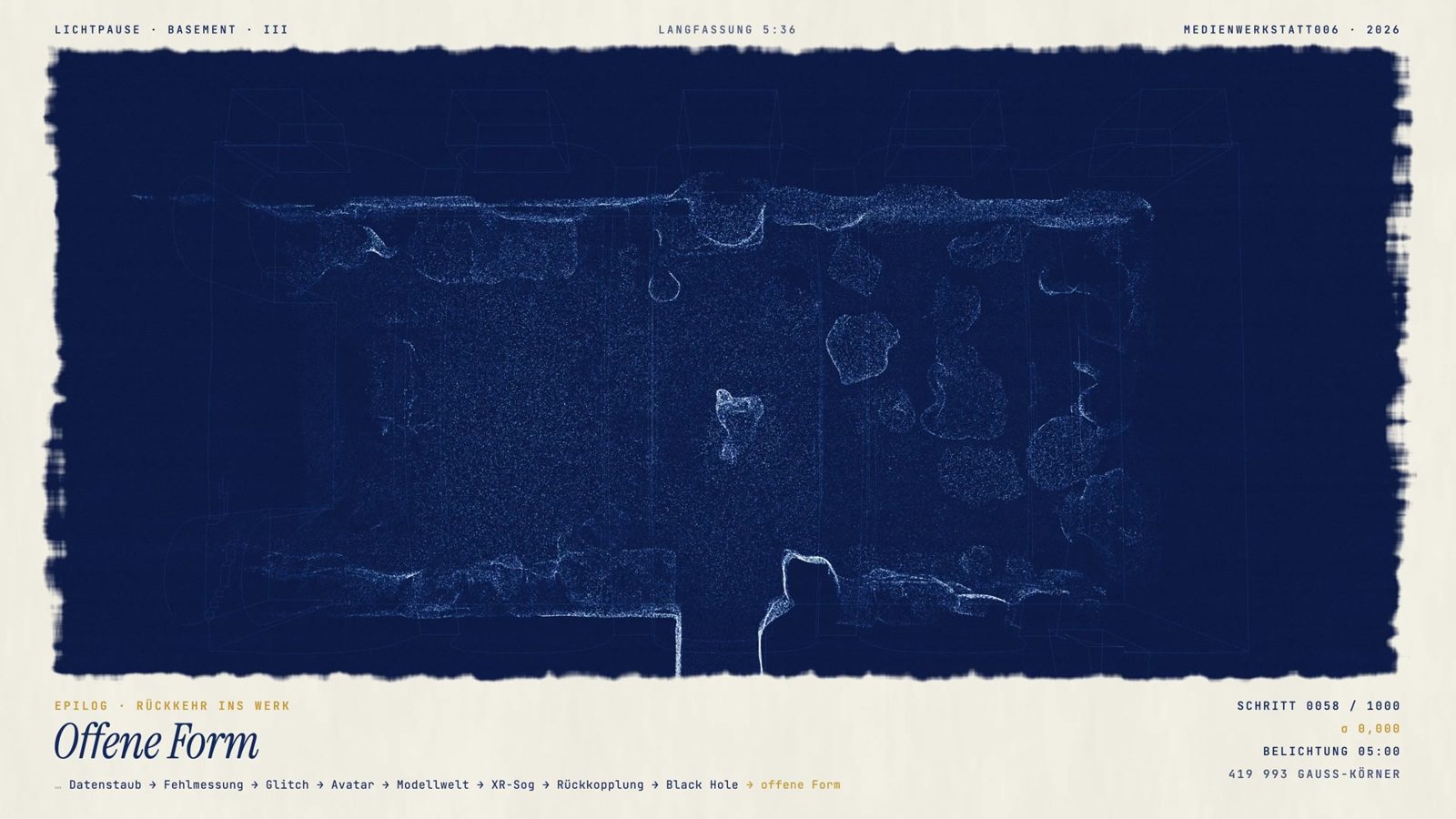
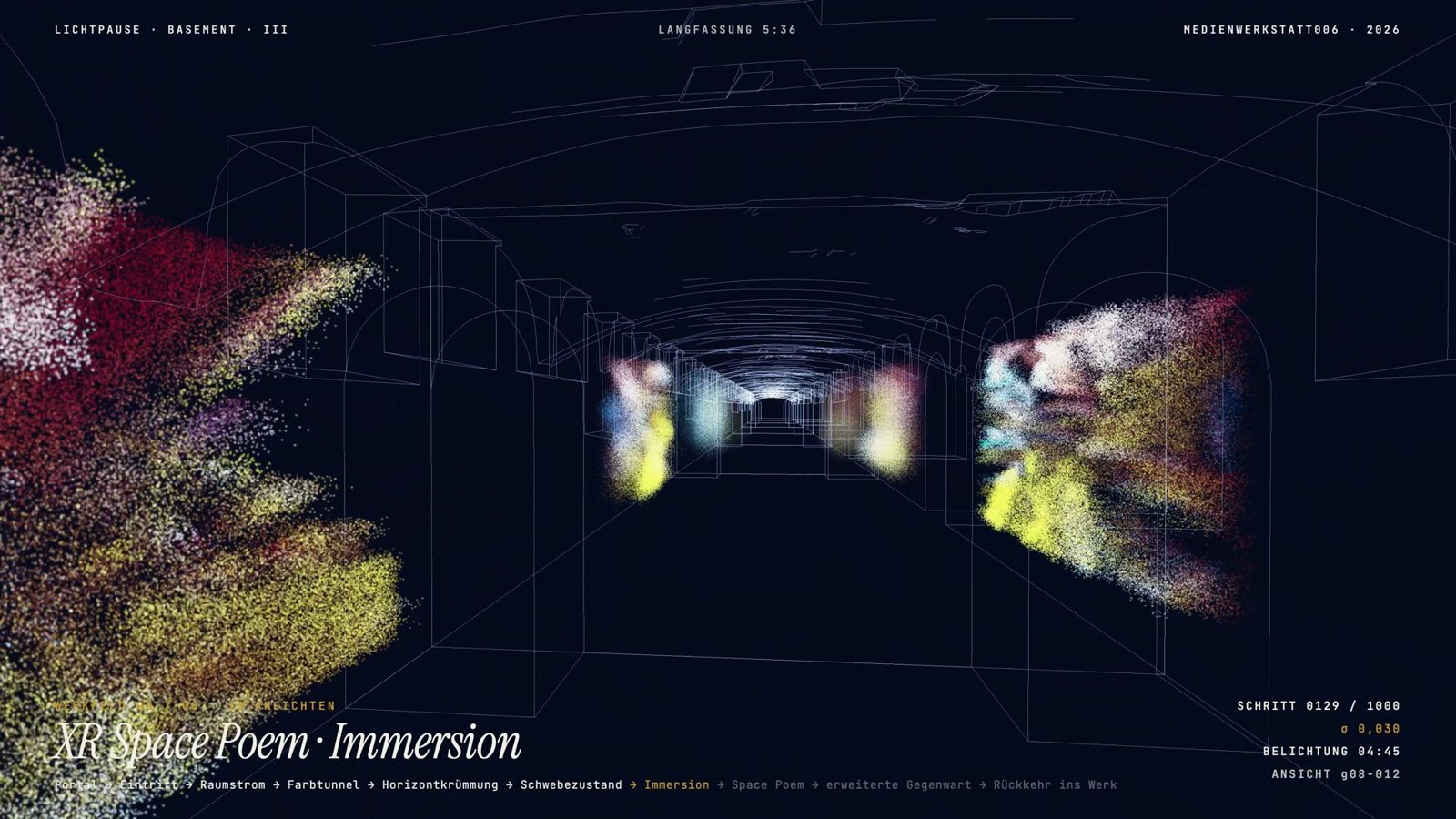
Eight work fields as eight exposures: frieze, stack, night image, point cloud, diorama, multiple exposure, turntable, tunnel – ending in the blueprint sheet.
The concept chain in seventeen exposures: each link first as a stencil of type, then as an open sheet.
Camera flight through the animated GLB scene: noise, exposure, 272 views, sediment, hallucination, blueprint.
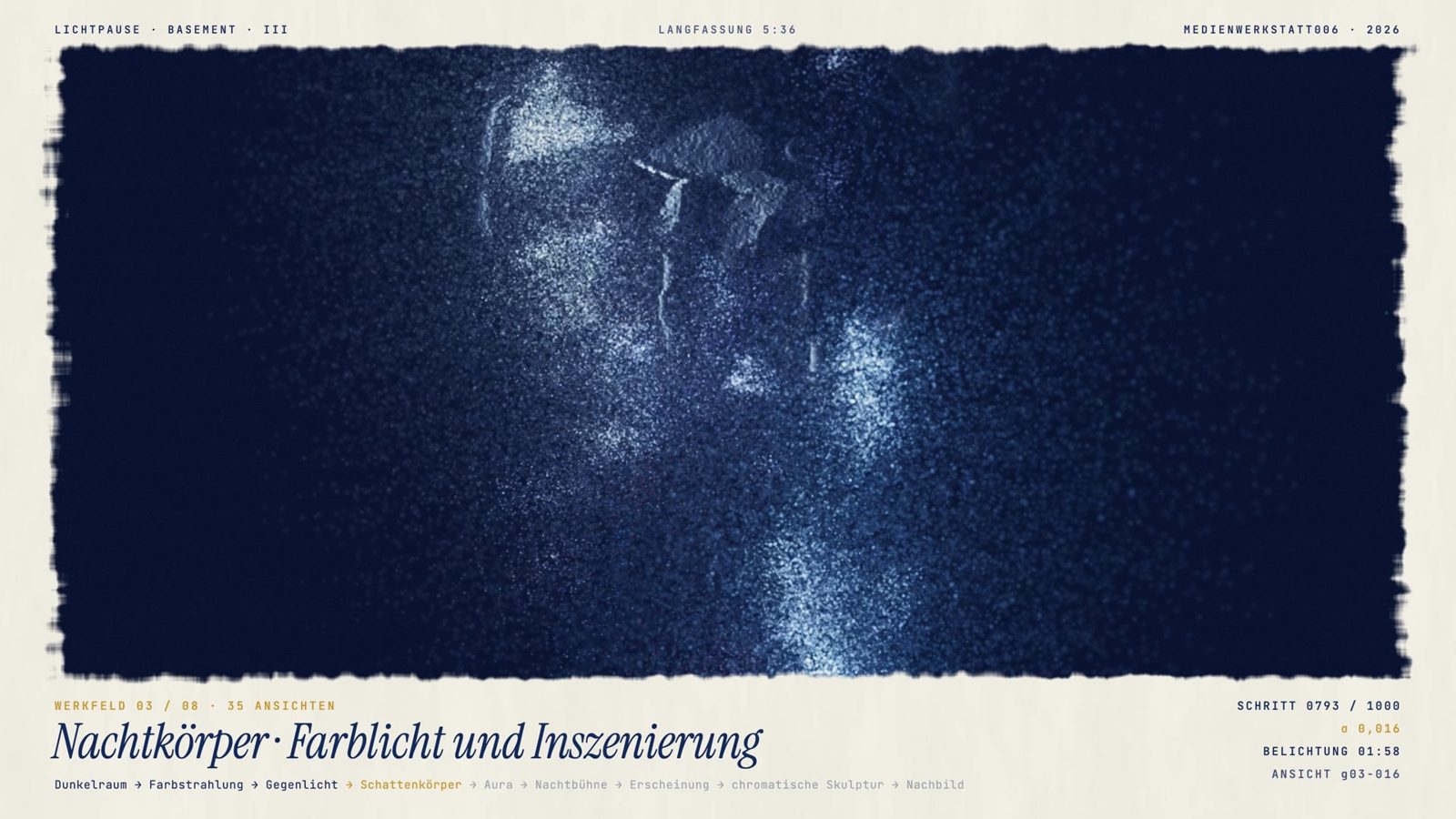
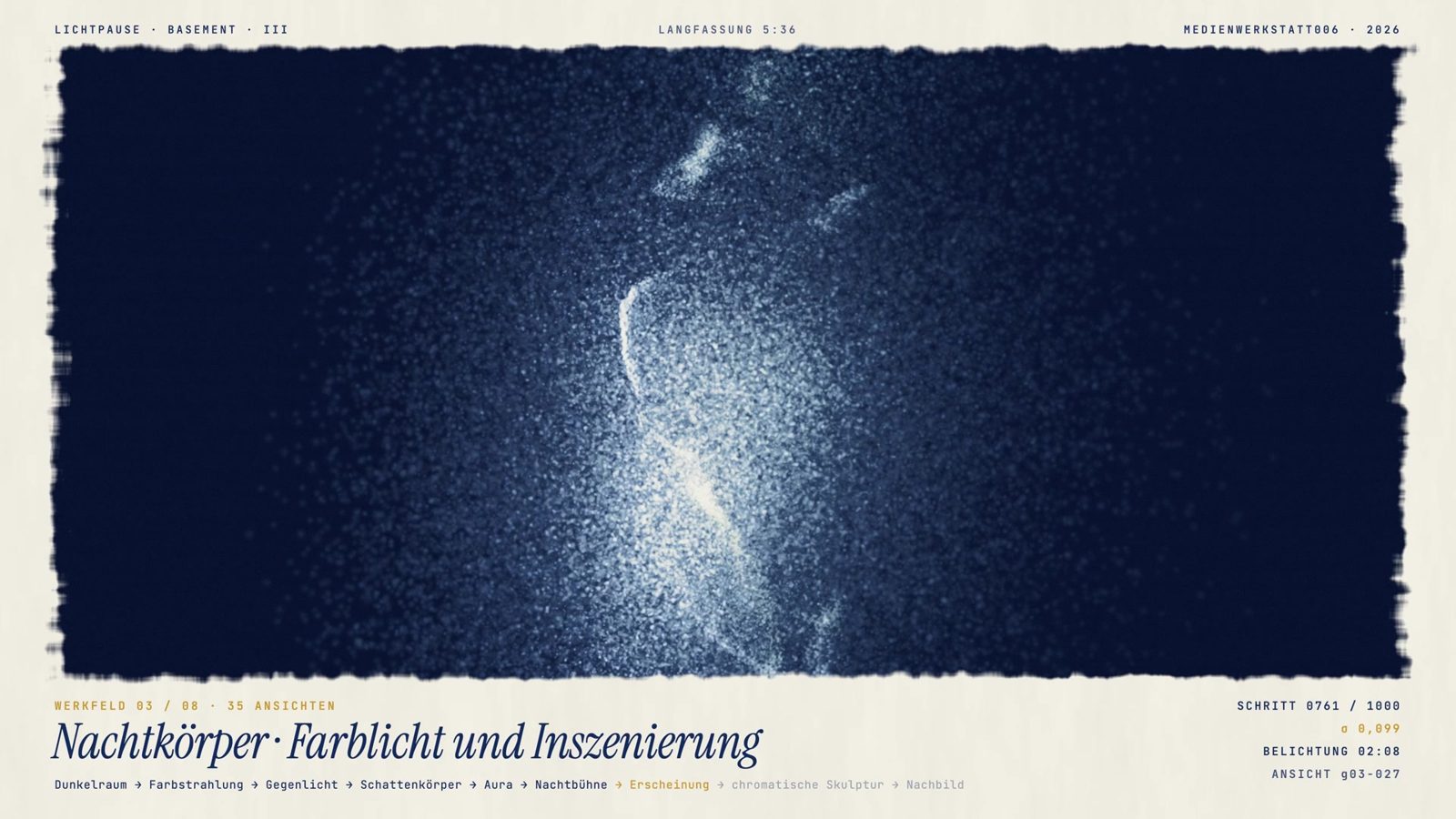
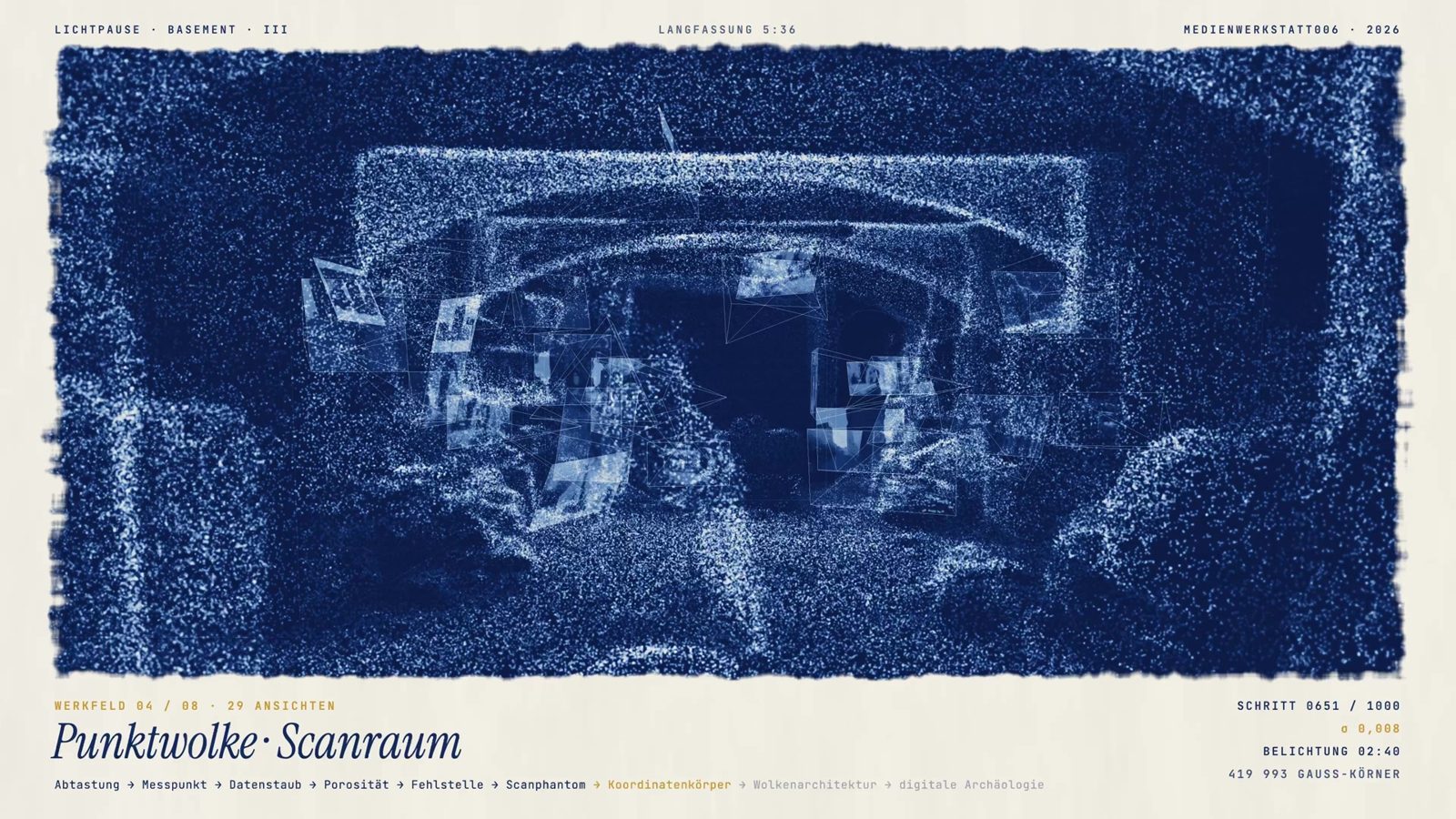
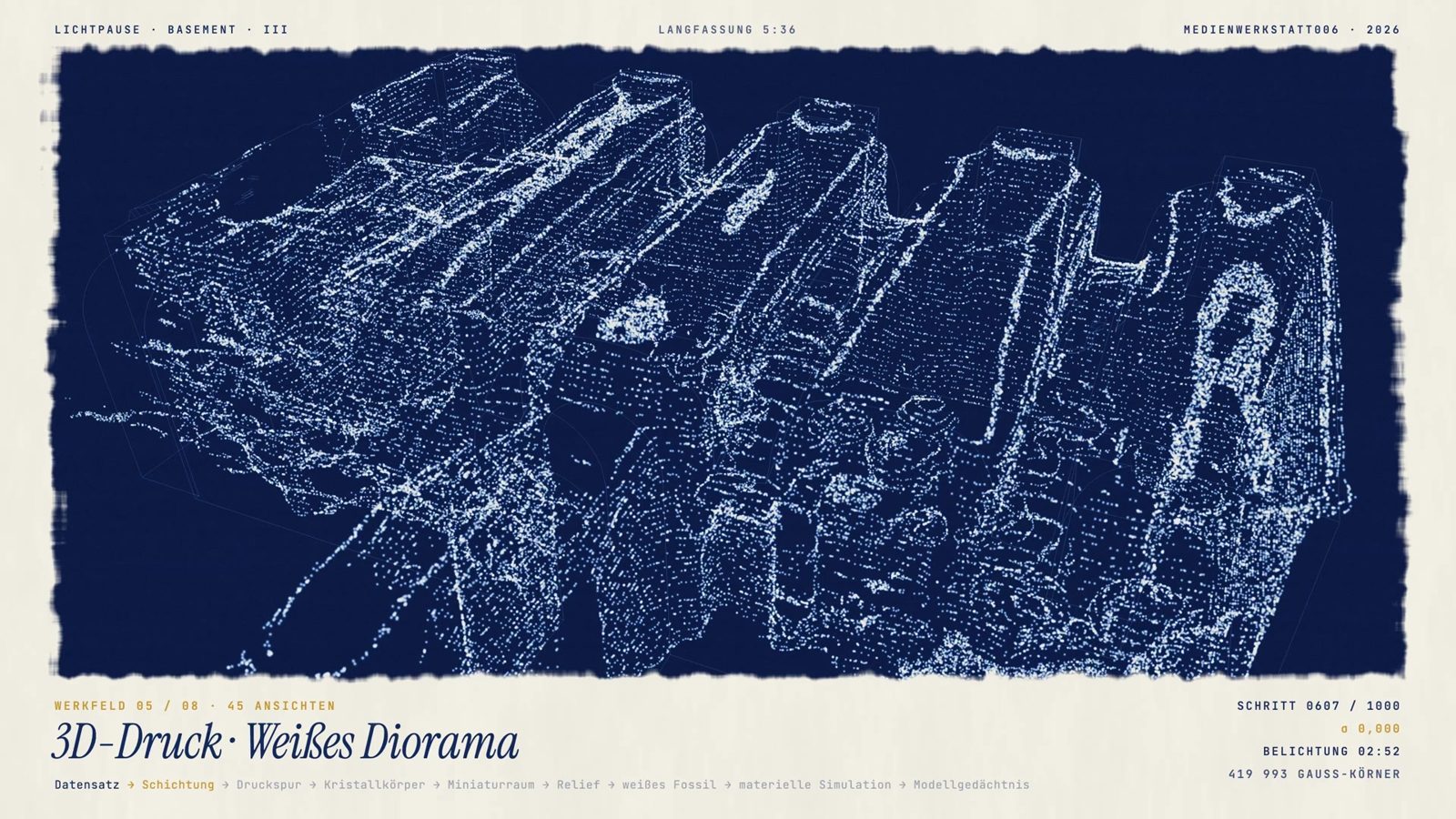
The exposer
Choose a work field and a motif. The slider is the diffusion schedule: at step 1000 the image is pure noise, at 0 it is learned. Holding the mouse down exposes single areas earlier – until they are over-exposed. “Wash” fixes the cyanotype, “Save” downloads it as PNG.
The 3D scene
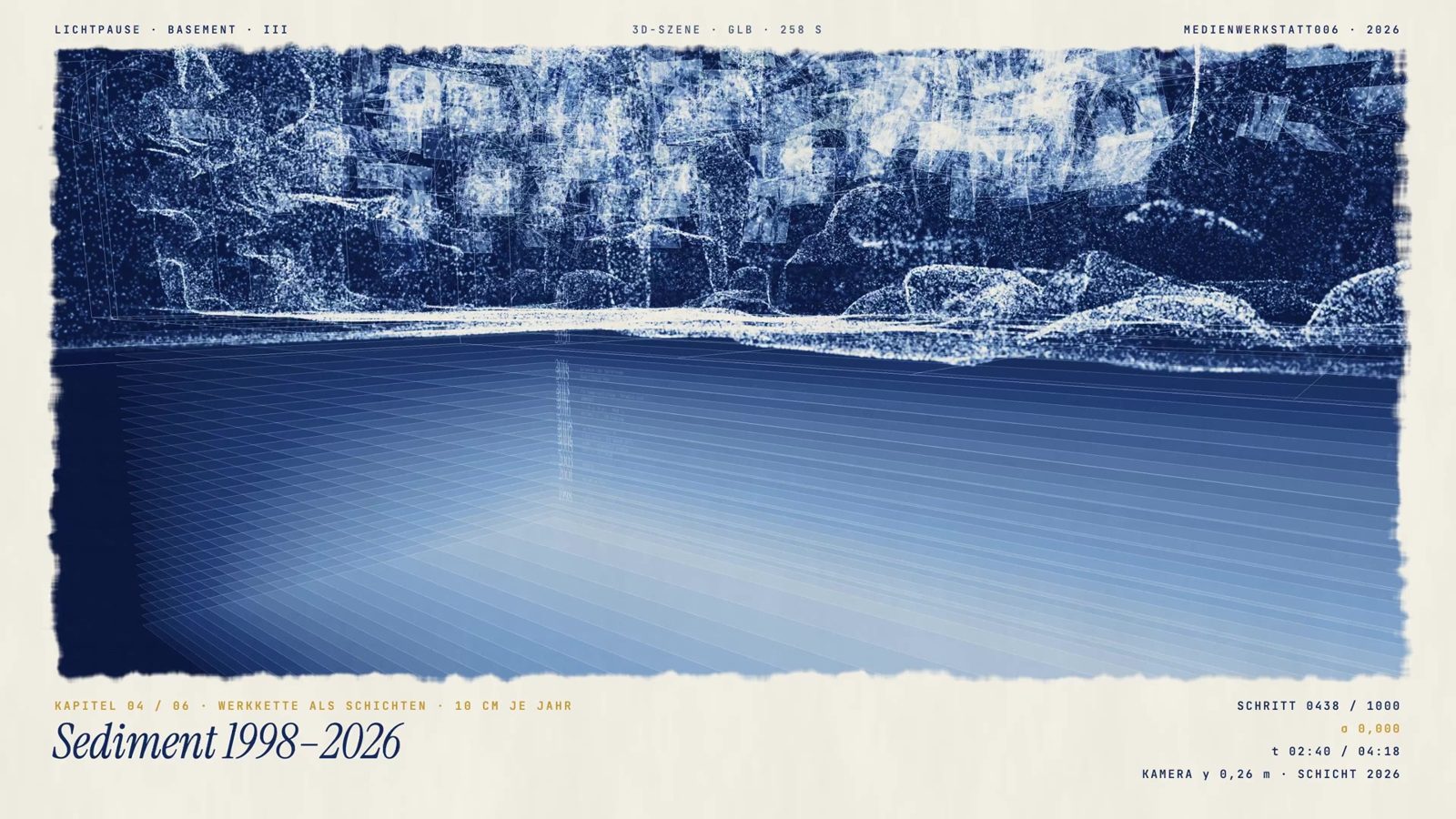
Reconstructed from the real scan and digital twin v2: the Gaussian grains with the morph target “noise” (weight 1 = noise, 0 = room), the twin as a blueprint of edge lines with a measuring grid, 272 training views as camera frusta in eight zones, the sediment 1998–2026 below the floor, the hallucination as a continuation of the vault, the blueprint sheet with plan and section at 1.2 m – and the camera of the 258 s animation.
- BASEMENT_III_LICHTPAUSE_2026.glbglTF 2.0 · animated · 31 MB
Sketchfab version: in preparation for the collection BASEMENT XR · 3D Collection ↗
Experience
The GLB animation in real time: play, jump along the timeline, film or free camera, layers on and off, σ by hand instead of from the animation, adjust development and exposure. A click on one of the 272 views opens the misreader: the archive image as a point relief right in the room.
Open in own window ↗ · desktop browser with WebGL2 recommended
Entrauschen
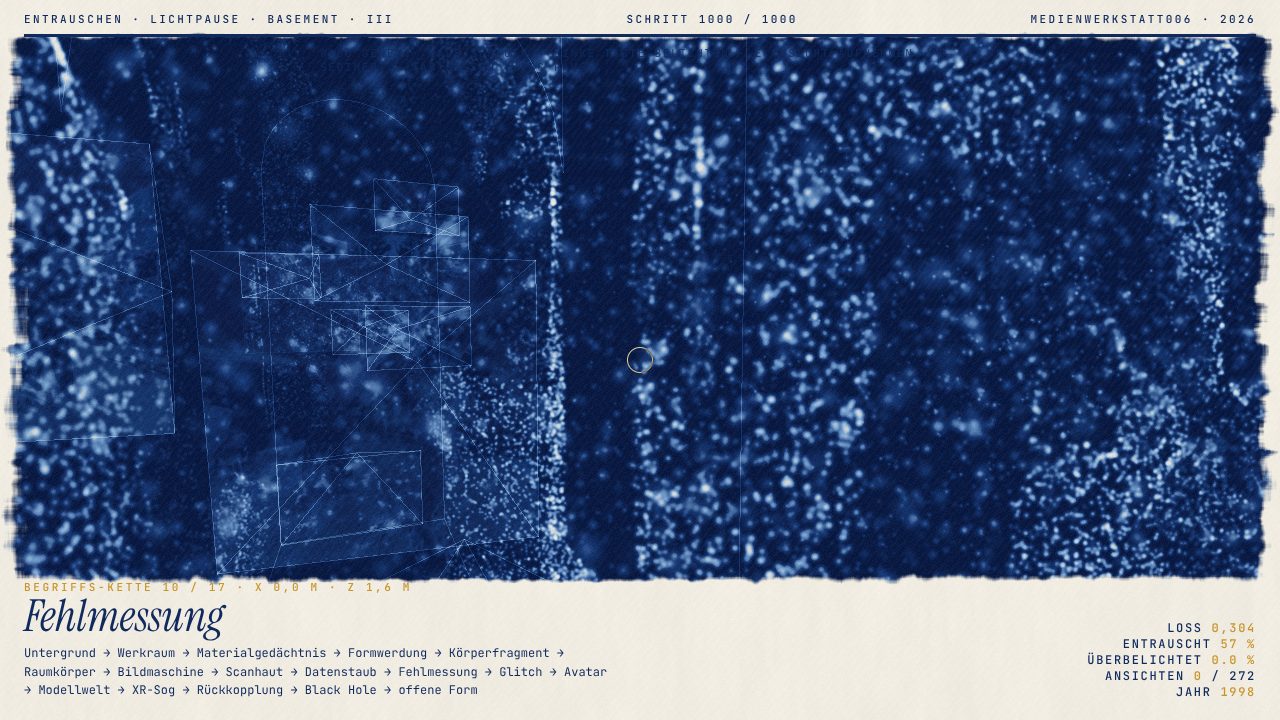
The cellar is pure noise. You are the light: wherever you expose, the room finds itself – cell by cell on a 0.5 m grid, σ = (1 − e)^1.3. The 272 training views lie hidden in the noise; they appear only once their surroundings are exposed and, when taken, pay into the timeline 1998 → 2026. Over-exposure makes the model hallucinate: the vault writes itself beyond the walls, and the loss punishes it twice. 1000 steps, one goal: loss below 0.15.
At the end: your own blueprint as PNG, your own model as GLB, an AR table model 1:50 as USDZ (iPhone/iPad: AR Quick Look) and the log as JSON. “Tab” opens the background on cyanotype, diffusion and Gaussian splatting.
Sediment 1998–2026
Below the cellar floor, the 3D scene holds one stratum per year. Earlier forms remain active as sediments in later images. Hover over the strata.
- 1998THE BODYBOX
- 1999
- 2000
- 2001MOVING GALLERY
- 2002
- 2003EUTOPIA
- 2004
- 2005PARSIFAL ENTFERNUNG
- 2006GRANAT · SILBERPFEIL & BOGEN
- 2007VIRUS ORFEUS · DIE ANDERE SEITE
- 2008TanzMedienAkademie 08
- 2009
- 2010RHYTHMUS 11 · 100 Drawings
- 2011Inside an Object · RAUM 11
- 2012GAMMARAY
- 2013Ein Sommernachtstraum · Paradise Lost
- 2014
- 2015Hyperillusion Graz
- 2016Bergwesen oder Natternhemd
- 2017
- 2018
- 2019
- 2020XR SPACE · BASEMENT
- 2021[XR] NOE | HUMAN NATURE
- 2022A moment snake and chess
- 2023Randnotizen
- 2024Pinhole – Rail-Reise der Sichtweise · smART Data BRIDGE Krahuletz
- 2025Heavenly Riders · GP≭FF[1914]
- 2026Kugelkopf ext. 8: LOK1000 · Lucid Dreams · happy Palace · Der schmutzige Blick
Nine elements
BASEMENT Studio Neulerchenfeld · Neulerchenfelder Straße 11 · 1160 Vienna · 48,21079 N · 16,33732 E · real scan 29.12.2020
References
- BASEMENT Studio Neulerchenfeld XR · Hybrider Werk SPACE – Black Hole · 1998–2026 · 272 images in eight work fields, misreader, AI / REAL / SPACE
- ATELIERS · VIENNA · REAL · BASEMENT · I Black Hole · BASEMENT · II Raum-Zeit-Kapsel · GANGLBAUERGASSE · I White balance · II KAPSEL 820
- Sketchfab · BASEMENT XR 3D Collection · mwintersberger · real scan studio_xr-space · xars hyperobjekt 29.12.2020
- Original recordings XR SPACE 08/09 2020 · photographs XR METABODY Atelier Neulerchenfeld
- John F. W. Herschel: On the Action of the Rays of the Solar Spectrum on Vegetable Colours, Philosophical Transactions of the Royal Society, 1842
- Anna Atkins: Photographs of British Algae. Cyanotype Impressions, 1843–1853
- Jascha Sohl-Dickstein et al.: Deep Unsupervised Learning using Nonequilibrium Thermodynamics, ICML 2015
- Jonathan Ho, Ajay Jain, Pieter Abbeel: Denoising Diffusion Probabilistic Models, NeurIPS 2020
- Bernhard Kerbl et al.: 3D Gaussian Splatting for Real-Time Radiance Field Rendering, SIGGRAPH 2023
- Chain of works 1998–2026: THE BODYBOX · MOVING GALLERY · EUTOPIA · PARSIFAL ENTFERNUNG · GRANAT · VIRUS ORFEUS · DIE ANDERE SEITE · TanzMedienAkademie 08 · RHYTHMUS 11 · Inside an Object · RAUM 11 · u. a.
Concept, archive, image, sound and realisation: Markus Wintersberger · medienwerkstatt006 · Vienna 2026