MARKUS WINTERSBERGER · 1994 / 1998 / 2026 · VERSION B
Wegfindung
PATHFINDER ⇄ THE BODYBOX
The body as terrain – the route as self-portrait
A second, entirely different re-translation. Version A read the 1991 scan as a measurement. Version B asks what a machine does with this body today: it estimates its depth, computes paths across its skin, tracks it as a shipment – and fails to classify it.
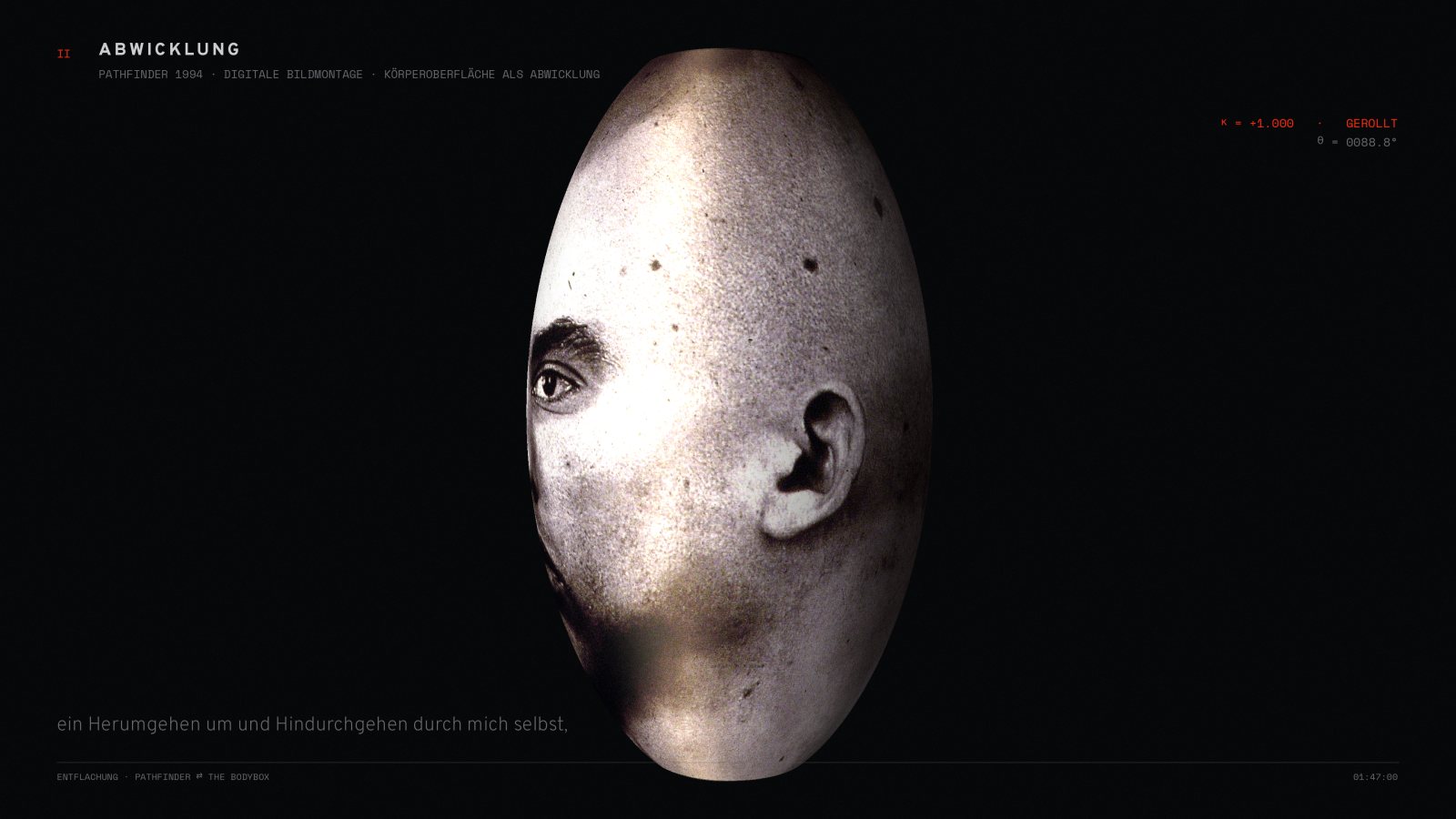
PATHFINDER (1994) was named like an algorithm long before wayfinding became everyday life. THE BODYBOX (1998) carried this skin on a container along the motorway. In 2026 both works are taken literally: the head becomes terrain, the route Vienna → Krems → Linz a path across the skin – and every computed path a self-portrait.
Keyword archive
PATHBODY · 1991–2026 · MOBILE VIA QR17,111artefacts · 1991–2026
Every trace of PATHFINDER and THE BODYBOX in one place: photographs, scans, montages, films, websites, 3D models with AR view and the source code of the five 2026 versions – each artefact with archive ID, checksum, keywords and locations. Search, timeline and full screen.

AV 2026
4K · 16:9 · MP4Translation
1994 / 1998 → 2026| 1994 / 1998 | 2026 · VERSION B | ||
|---|---|---|---|
| Eye | simulated camera eye flies over the skin (1994) | → | machine vision estimates depth, detects, classifies |
| Path | flight path of the animation »pathfinder« | → | path search: Dijkstra, A*, flow field – the path as computation |
| Skin | unwrapped body surface as landscape | → | cost field: brightness and slope become resistance |
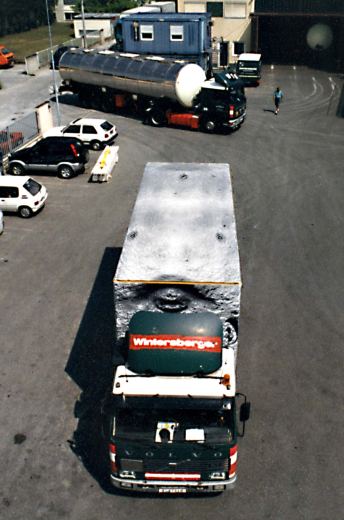
| Transport | truck with container Vienna → Krems → Linz (1998) | → | parcel tracking · telemetry · station by station |
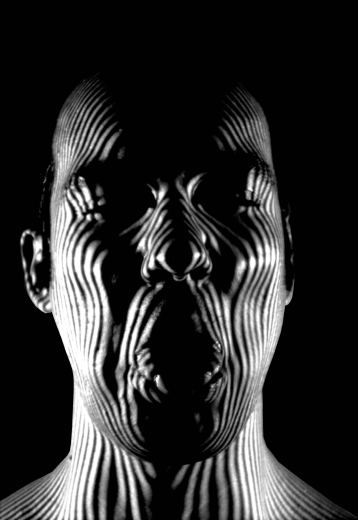
| Body | full-body scan in striped light (1991) | → | point cloud · LiDAR scan · data set |
| Self | “an ‘other’, yet a ‘familiar strangeness’” | → | classifier without a class: “Other” |
Zeitgeist. In 1994 the simulated camera eye was a utopia of the gaze: a flight over a skin that becomes landscape. In 2026 the eye is infrastructure. It measures depth from a single photograph, recognises vehicles by confidence values, steers supply chains and computes the cheapest path in milliseconds. Version B translates both works into this language – precisely, without illustrating them.
Historical perspective. Nothing is newly invented: all images come from the 1991–1998 archive – striped-light photographs, head unwrappings, body nets, the photographs of the journey to Linz. The methods are old enough to have a history: Dijkstra 1956/59, A* 1968. The 1994 work bore the name of an algorithm before it was an everyday word – Version B redeems this name.
Guidance system. The visual language is that of the road: asphalt, white lane marking, traffic yellow, signage typography, telemetry in monospace. Chapter changes are wavefronts of a Dijkstra search, every caption a sign, every number a reading. The journey Vienna → Linz (200.8 km) is the counter that film, website, 3D scene and game align to.
Other. The end is not a result but a remainder: the classifier finds no class above the threshold for the 1991 head. The 1996 quotation becomes a technical diagnosis – “Searching for myself I find an ‘other’, yet a ‘familiar strangeness’.”
Chapters
LONG 5:36 · TRAILER 3:44
00Opening
LONG 0:00 · TRAILER 0:00A stream of particles finds its way to the title: each point follows the slope of a cost field until the word WEGFINDUNG stands.

01I · Depth
LONG 0:22 · TRAILER 0:14Eight segments of the 1991 full-body scan become point clouds: monocular depth from silhouette and striped light – the machine eye estimates what the photograph never measured.

02II · Terrain
LONG 1:12 · TRAILER 0:41The 1994 head unwrapping as a cost field. Dijkstra spreads as a wavefront and finds the way from ear to ear – then the camera travels into the left eye.

03III · Swarm
LONG 2:04 · TRAILER 1:08Thousands of agents follow a flow field across the body net: many paths become a vascular system, a delta, an image of nerves.

04IV · Shipment
LONG 2:58 · TRAILER 1:35The 1998 journey photographs, read by a machine: detection frames, confidence values, parcel tracking station by station – the sculpture as freight.

05V · Point flight
LONG 3:54 · TRAILER 2:02The container as a LiDAR point cloud on the A1: the road only appears in the scanning beam, speed dissolves it again.

06VI · Other
LONG 4:46 · TRAILER 2:29The head, frontal, 1991, in the classifier: person, object, container, landscape, map – no class rises above the threshold. “Other”.

07Credits
LONG 5:14 · TRAILER 3:23Credits, references, methods and links – on asphalt, between two lane markings.
Parcel tracking
BODYBOX 1998 · 8 STATIONSThe sculpture as freight: enter a tracking number – the 1998 journey is followed station by station, every archive photograph read by a machine.
 MACHINE VIEW · CLICK = RAW IMAGE
Archive photographs of the journey Vienna → Linz, 1998. The detection frames are staged machine vision – set by hand, not computed by a trained network; the values are claims, as every classification is.
3D · Experience · Game
PAGES


Methods
PYTHON · NUMBA · THREE.JS- Depth
- Monocular depth estimation from silhouette (distance transform, hole filling) and striped-light intensity; up to 420,000 points per segment.
- Terrain
- Cost field from slope and brightness of the head unwrapping; geodesic Dijkstra search (scikit-image MCP); wavefront as image event.
- Swarm
- 36,000 agents in a flow field (gradient of the distance to a goal), 900 steps – traces accumulated as luminance.
- Shipment
- 1998 archive photographs with staged detection frames (set, not trained), station band, mini map, odometer.
- Point flight
- Container as point cloud (520,000 points), simulated LiDAR scan by elevation angle, road as point field.
- Rendering
- Own point and triangle rasterizer (Python · NumPy · Numba), 3840 × 2160 · 25 fps, H.264 High 5.1; sound synthesised numerically, −16 LUFS.
- Web
- three.js r169 · WebXR immersive-ar with hit test (Android/Quest), otherwise camera window · glTF 2.0 with KHR_materials_unlit · desktop app with Electron.
Cycle
1991 → 2026Version B builds on Version A and is woven into it: the same archives, the same route, the same dimensions (720 × 265 × 250 cm) – a different question.
References
WORKS · METHODS · LITERATURE- PATHFINDER. Digitale Bildmontage 1994Photography · animation · video · full-body scan in striped light 1991 · medienwerkstatt006.at/pathf.htm
- THE BODYBOX. Skulptur in Bewegung 1998Truck · container · animation · video · performance · O.K Centre for Contemporary Art Linz, “Natürlich Künstlich” 1998
- ENTFLACHUNG · Version A 2026Measuring light – the 1991 scan read as striped-light measurement · long 6:24 · trailer 2:44 · 3D 2:22
- E. W. DijkstraA Note on Two Problems in Connexion with Graphs · Numerische Mathematik 1, 1959, 269–271
- P. E. Hart, N. J. Nilsson, B. RaphaelA Formal Basis for the Heuristic Determination of Minimum Cost Paths · IEEE Transactions on Systems Science and Cybernetics 4 (2), 1968
- Vilém FlusserDigitaler Schein · in: Medienkultur, Frankfurt/Main 1997
- Methodsmonocular depth from silhouette and striped light · geodesic costs (scikit-image MCP) · flow-field swarm · simulated LiDAR scan · Python · NumPy · Numba · OpenCV · FFmpeg · three.js · WebXR
- ProductionConcept · image · sound · code: Markus Wintersberger · medienwerkstatt006 · Vienna 2026 – in dialogue with Claude (Anthropic) · no generative image AI: all images from the 1991–1998 archive