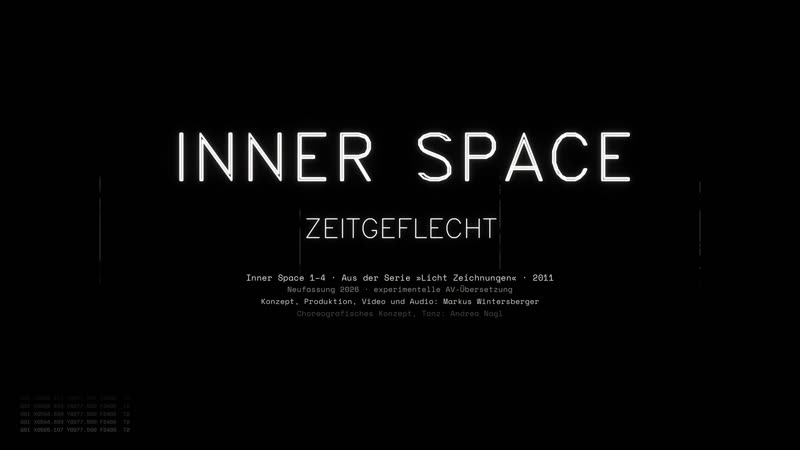
Opening titles
LONG 0:00–0:24 · TRAILER 0:00–0:12A milling head writes the title in Hershey single-stroke lettering; the toolpath runs alongside as G-code. Behind it four slits open — the four centres.
MARKUS WINTERSBERGER · ANDREA NAGL · 2011 / 2026
Zeitgeflecht · time weave · light · time · movement
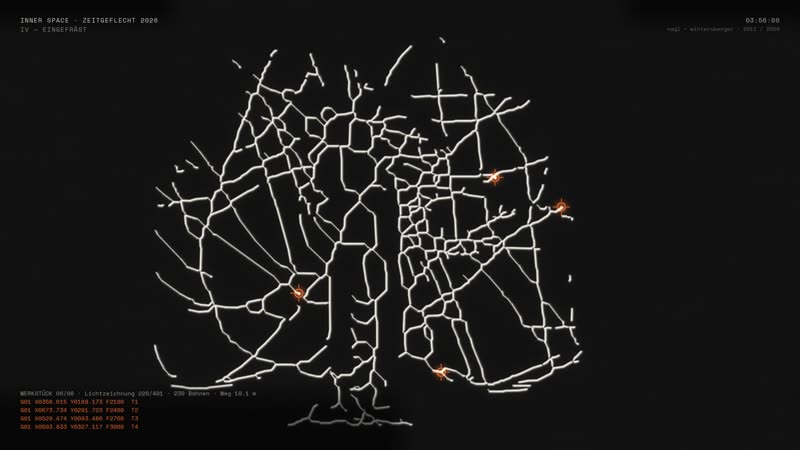
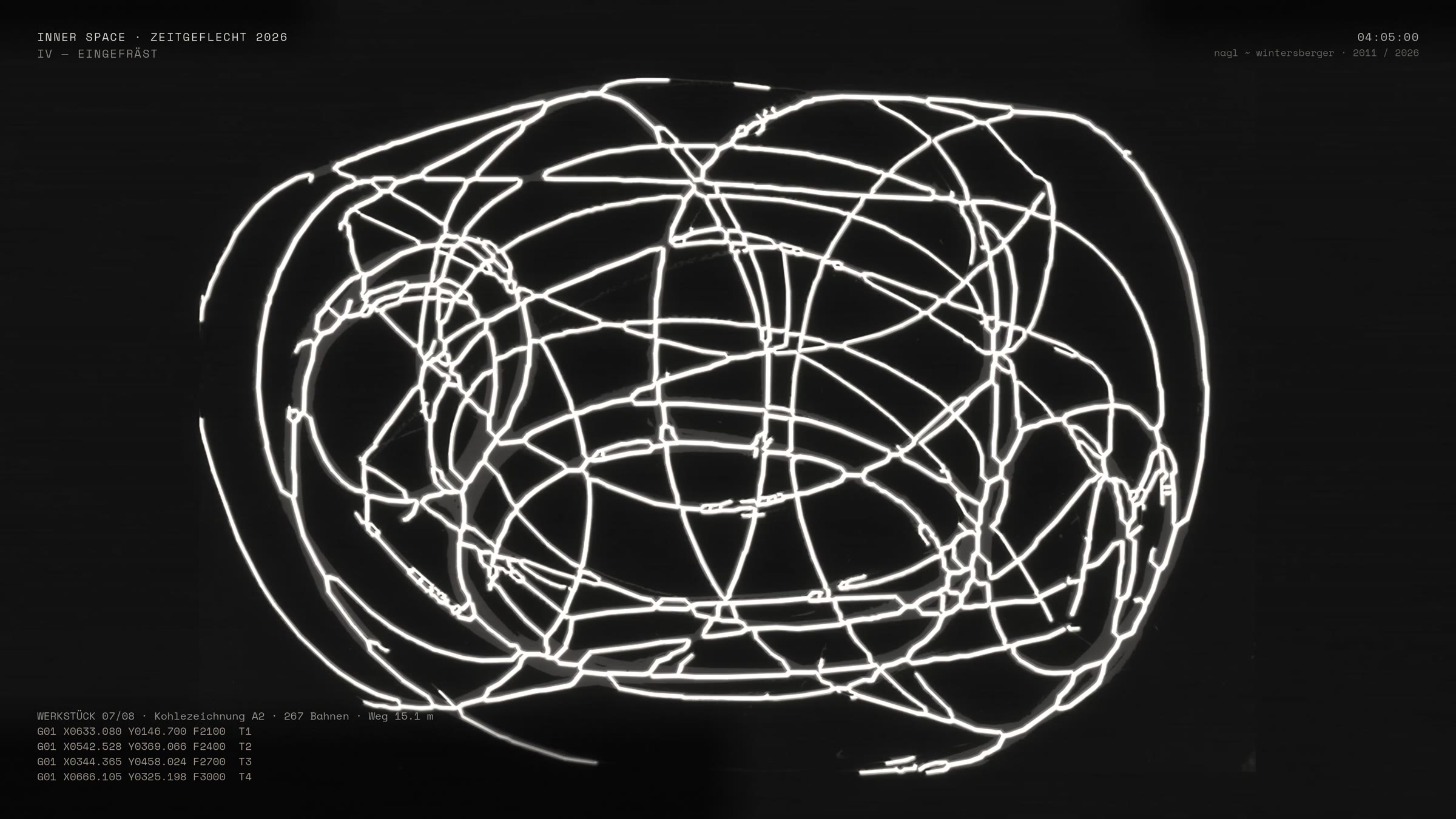 IV — MILLED IN · 04:05
In 2011, four sequences by choreographer Andrea Nagl simultaneously filled the picture space: a dancer embedded in a field of light drawings fed in live. In 2026 the metaphors of the work text are taken literally — the time weave is woven, the light trace is driven by the body, milling in becomes a toolpath, the space of time a single image.
The new version works exclusively with the 2011 material: the video of the four sequences (1280 × 720, 24 fps, with original sound), 401 light drawings and ten charcoal drawings in A2. Each chapter translates one sentence of the work text into an image process of its own — time offset, weaving, optical flow, toolpath, summed image.
The visual language was developed specifically for this work: strict black and white between light and charcoal, the polarity of the drawings as dramaturgy, a single accent colour — the glow of the milling head — and a single-stroke vector font (Hershey) that is written as a toolpath, not typeset. The titles of these pages are the same paths.
The sound is made only from the original 2011 sound: as a canon of the four centres, as granulation in the rhythm of the weaves, as sonification of the optical flow, as spindle tones of the mill and as 401 inscriptions. No generative AI.
Four sequences by choreographer Andrea Nagl simultaneously fill the picture space. The dancer is embedded in a field of light drawings fed in live. Every movement seems to change the respective light trace.Markus Wintersberger, work text 2011
A milling head writes the title in Hershey single-stroke lettering; the toolpath runs alongside as G-code. Behind it four slits open — the four centres.
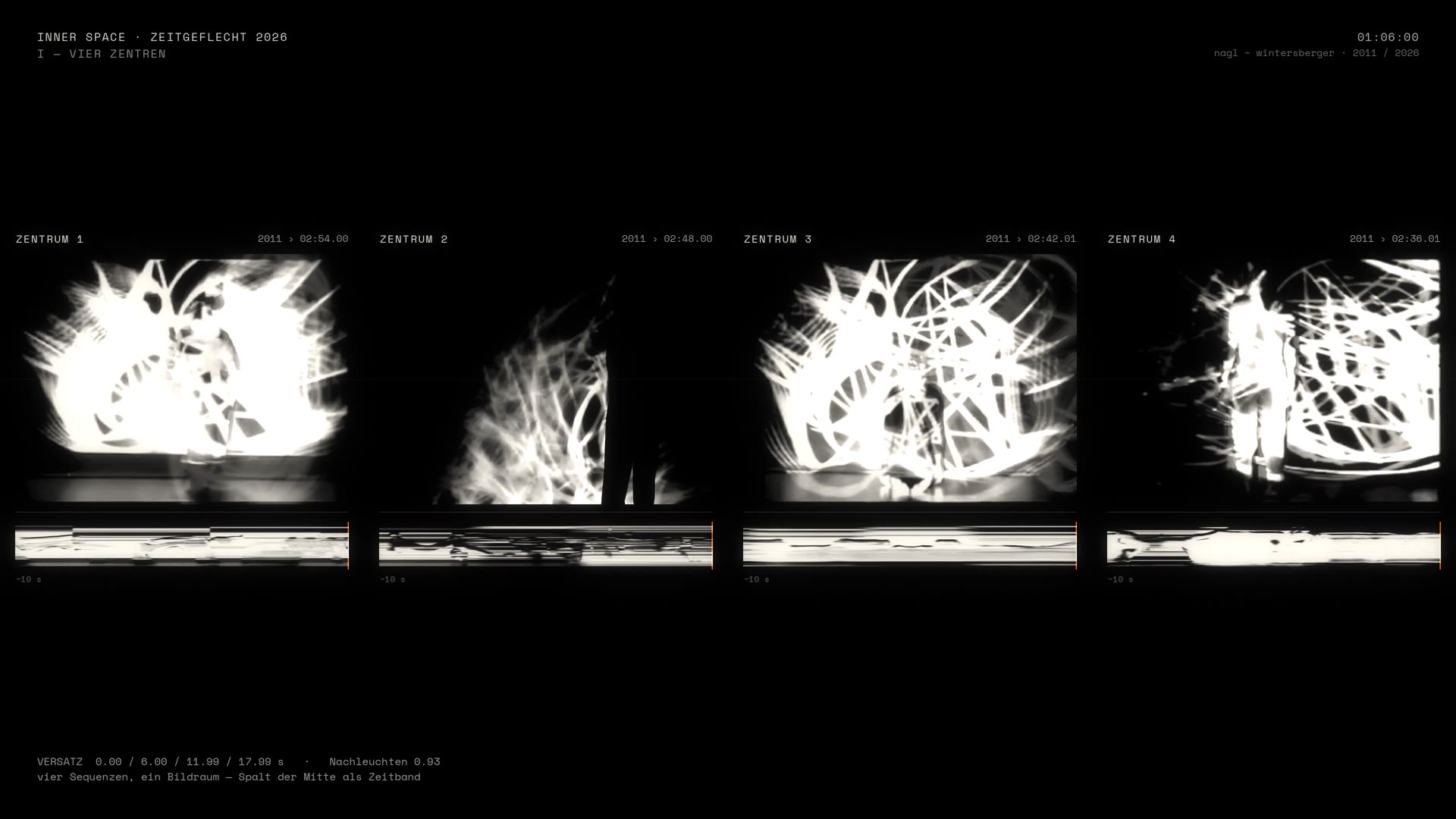
The four sequences of 2011 run side by side and are pulled apart in time (up to 18 s offset in the long version). Afterglow turns movement into trace; beneath it, the centre slit of each sequence becomes a time band.
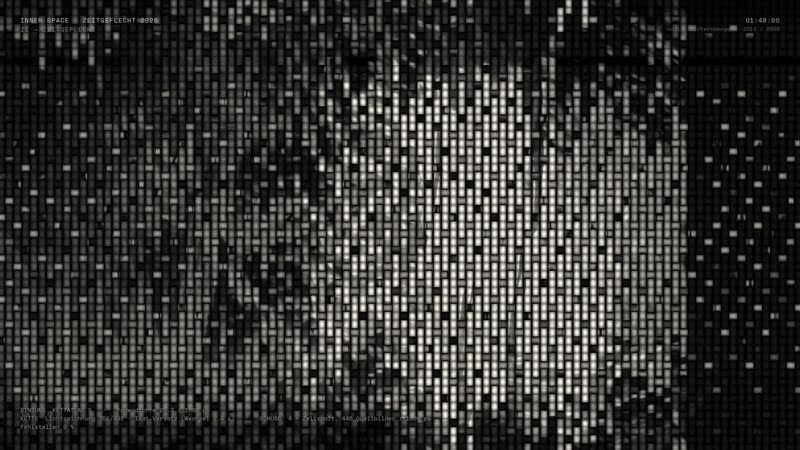
An actual fabric: warp = light drawing, weft = time slit of the four sequences. Plain weave, twill 2/2, warp satin 5 and basket weave follow one another; an ikat offset shifts the warp threads in time, and finally threads drop out.
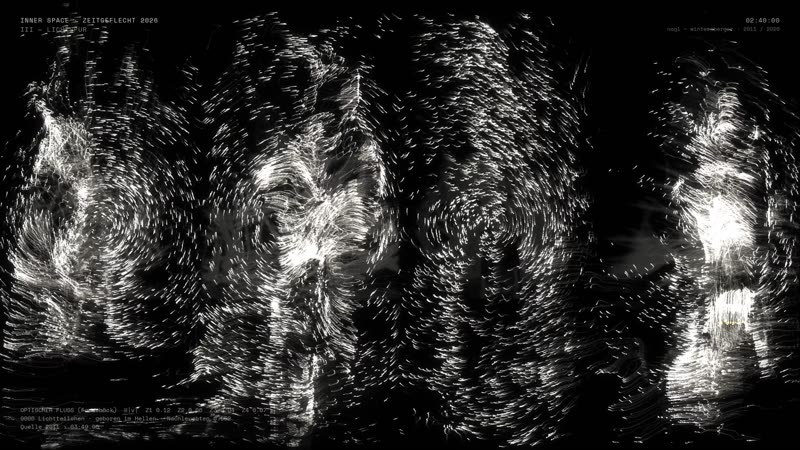
The dancer’s optical flow (Farnebäck) drives 9,000 light particles. They are born in the bright areas, follow the movement and glow on as traces; vortices around the four centres turn the space into a partner.
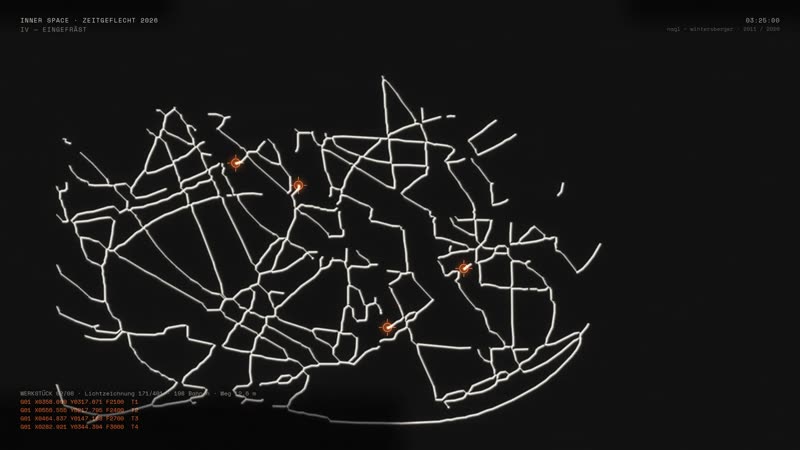
Charcoal and light drawings are skeletonised and milled as toolpaths into a graphite plate by four spindles T1–T4. Then the light of the drawing falls into the grooves.
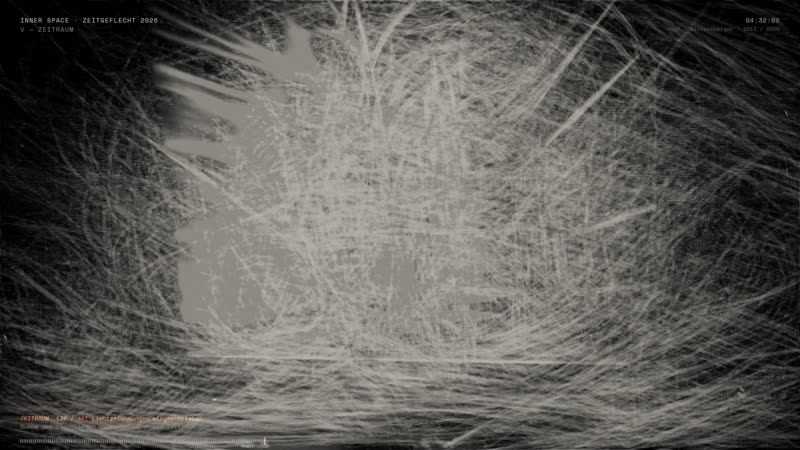
All 401 light drawings are inscribed at speed; their light lines add up to a single image — a space of time. Finally it flips into the polarity of charcoal.
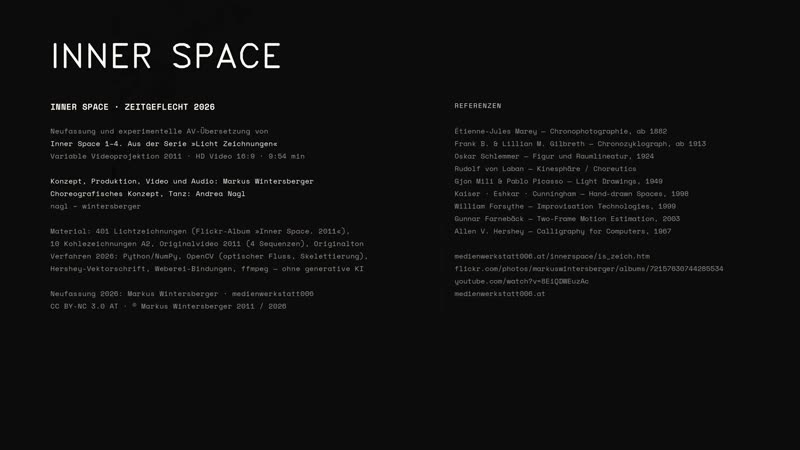
Contributors, material, methods, references and links.
Four weaves order the time weave. White = warp thread (light drawing) on top, black = weft thread (time slit of the four sequences) on top.
Warp and weft. The warp threads carry a light drawing, the weft threads the centre slit of the four sequences over the whole duration of the video – time as thread. Where the weave lifts the warp, the image appears; where the weft lies on top, time does.
Optical flow. Between two frames of each sequence the motion per pixel is estimated (Farnebäck 2003). This vector field drives light particles – the light trace really does respond to the dancer’s movement.
Toolpath. Charcoal and light drawings are thinned to one-pixel skeletons (Zhang-Suen), traced into paths, simplified and ordered by nearest neighbour – the way a milling machine would run them. Four spindles share the paths.
Summed image. Of each of the 401 light drawings only the light line remains (high-pass); the lines are added and compressed with 1 − e−x. Inverted, the space of time reads like a charcoal drawing.
All four methods to try yourself: Lab (DE) →
Everything audible comes from the original 2011 sound – stretched, granulated, filtered, delayed. Seven excerpts from the long version, twenty seconds each.
AAC 128 kbit/s · excerpts from the master (−16 LUFS). Playback starts only after a click.
Concept, production, video and audio: Markus Wintersberger
Choreographic concept, dance: Andrea Nagl
Earlier pages (DE): Lichtzeichnungen 1–100 (2011) · Inner Space 1–4 · Video (2011) · Kohlezeichnungen (2011)
The images respond to the dancer’s movements, make visible, as it were, the invisible time weave of her choreography and carry the play of forces into the space. The space itself becomes an interacting partner, in whose centres the dancer invents herself.Markus Wintersberger 2011
The four methods to try yourself: draw in four centres and export as G-code, design your own weaves, drive the dancer’s light trace, sum 401 images.
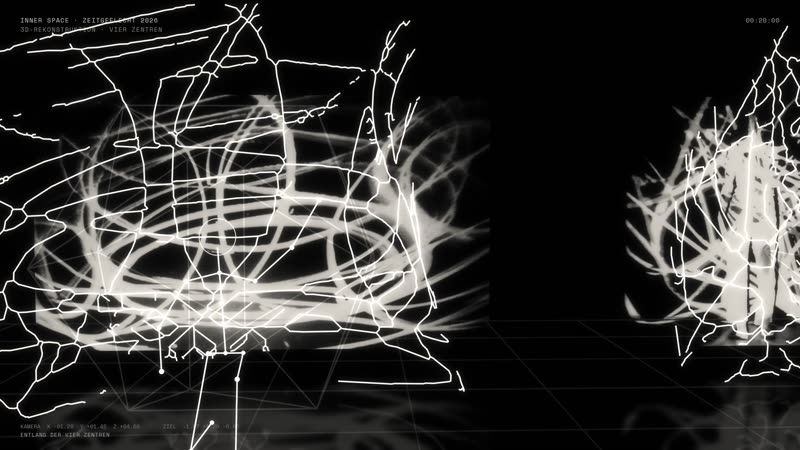
Walk-through reconstruction of the four centres as a glTF model with hotspots, camera moves, AR view, Sketchfab and the 3D animation 1:30.
The complete image archive “Inner Space. 2011” – sortable by album, brightness, density and sharpness, filterable by polarity.
Diese Seite auf Deutsch – mit Labor, 3D-Bühnenraum und Archiv.
| Concept, production, video and audio | Markus Wintersberger |
|---|---|
| Choreographic concept, dance | Andrea Nagl |
| New version 2026 | Markus Wintersberger · medienwerkstatt006 |
| Material | Video “Inner Space 1–4” (2011), 401 light drawings, 10 charcoal drawings A2, original sound |
| Licence | CC BY-NC 3.0 AT · © Markus Wintersberger 2011 / 2026 |
| Work | Format | Duration | Frames | Sound | Link |
|---|---|---|---|---|---|
| Long version | 3840 × 2160 · 25 fps · H.264 High 5.1 | 5:22 | 8 050 | AAC 256 kbit/s · 48 kHz · −15.9 LUFS · −1.5 dBTP | YouTube ↗ |
| Trailer | 3840 × 2160 · 25 fps · H.264 High 5.1 | 2:38 | 3 950 | AAC 256 kbit/s · −16.2 LUFS · −1.0 dBTP | YouTube ↗ |
| 3D animation | 3840 × 2160 · 25 fps · H.264 High 5.1 | 1:30 | 2 250 | AAC 256 kbit/s · −16.0 LUFS · −2.5 dBTP | YouTube ↗ |
| 3D stage space | glTF 2.0 (GLB) · animation “Space as Partner” 40 s | — | — | — | Sketchfab ↗ |
Methods: custom render pipeline in Python/NumPy with OpenCV (optical flow after Farnebäck, skeletonisation), Hershey single-stroke font, weaves as masks, custom line renderer for the 3D animation, ffmpeg/x264. Sound: custom Paulstretch stretching, granulation, filter banks, loudnorm. No generative AI. These pages: static HTML, fonts and 3D viewer (model-viewer) served locally, YouTube and Sketchfab only after consent.
More new versions 2026 (DE): INSIDE AN OBJECT — INNERSPACE 2026 · A MOMENT SNAKE AND CHESS — HÄUTUNG DES AUGENBLICKS · UNSTERN 2026 · DIE ANDERE SEITE — GLASWAND · SPURENKÖRPER · EUTOPIA — NEUE FASSUNG